Developing a new silicone product often starts with an idea, a reference image, or an existing product that needs improvement. Turning that idea into a market-ready product takes more than finding a custom silicone products manufacturer and paying for a mold.
For many brands and product developers, the biggest challenges come before mass production: understanding mold costs, confirming product structures, evaluating samples, and avoiding unnecessary design changes.
Choosing the right custom silicone products manufacturer at this stage can make a significant difference in both development costs and production efficiency.
For brands developing custom silicone products for pet industry, especially feeding bowls, lick mats, slow feeders, and other pet accessories, here are six important points to consider before investing in a custom silicone mold.
1. Define Your Product Requirements Before Requesting a Mold Quote
One common mistake in product development is requesting a mold quotation before the product specifications are clearly defined.
A reference image may show the general appearance, but it rarely explains everything a manufacturer needs to know.
Before requesting a quotation, try to clarify:
- Product dimensions, thickness, and weight.
- Silicone material requirements and hardness (Shore A).
- Color, surface texture, and logo placement.
- Functional requirements and intended usage.
- Expected order quantity and annual production volume.
- Applicable material safety and testing requirements.
For example, a silicone lick mat may look simple, but its groove depth, surface texture, thickness, and suction cup design all affect its functionality and mold structure.
The more clearly these details are defined, the easier it is for manufacturers to evaluate production feasibility and provide a more accurate quotation.
If you only have a reference image, you can still start the discussion. However, additional design clarification may be needed before the final mold cost can be confirmed.
2. Evaluate the Product Structure Through DFM Before Opening the Mold
Design for Manufacturing (DFM) is an important step that is often overlooked by first-time buyers.
A product may look attractive on a screen but still be difficult or expensive to manufacture.
Before opening a custom silicone mold, the manufacturer should review whether the product design is suitable for the selected molding process.
Some key areas include:
- Wall thickness: Uneven thickness can affect material flow, curing, and product consistency.
- Grooves and details: Deep textures or complicated patterns may increase mold complexity and make cleaning or demolding more difficult.
- Undercuts: Certain structures can complicate demolding and may require additional mold design considerations.
- Parting lines: Their positions can affect product appearance and the location of potential flash.
- Venting and shrinkage: These need to be considered to reduce molding defects and dimensional variations.
For pet products, these details also influence the final user experience.
For instance, a lick mat with overly narrow grooves may be difficult to clean, while an unsuitable suction cup structure may reduce its grip on smooth surfaces.
A reliable manufacturing partner should not simply reproduce the original design. They should also identify potential production issues and suggest practical adjustments before tooling begins.
This is where DFM helps reduce unnecessary mold modifications and avoidable development costs.
3. Understand What Actually Determines Custom Silicone Mold Costs
Mold quotations can vary considerably between manufacturers, even when the products look similar.
This does not automatically mean that the lowest quotation is the best choice.
Several factors influence the total mold investment:
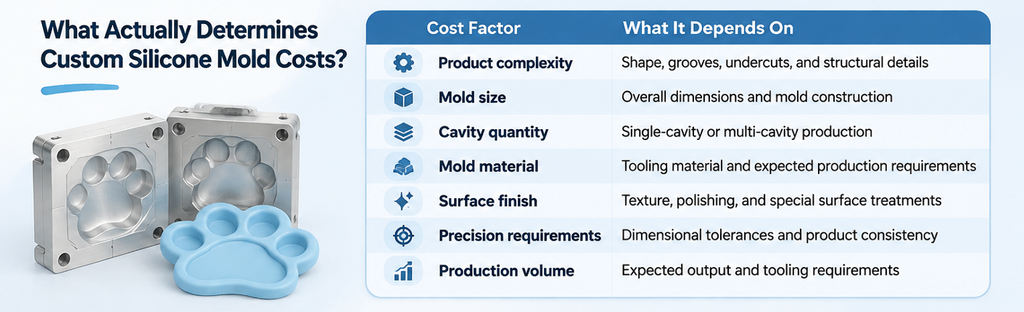
It is also important to understand what the quotation actually includes.
Before confirming an order, ask whether the quotation covers:
- Mold design and manufacturing.
- Initial mold trials and sample production.
- Sample revisions and additional trial costs.
- Mold maintenance and repair.
- Mold ownership and storage arrangements.
Another important consideration is the relationship between mold investment and future unit costs.
A more complex mold may require higher initial investment but could be more suitable for long-term production. On the other hand, a simpler mold may be more practical for a product that is still being tested in the market.
The right decision should consider both the initial tooling budget and the expected lifetime production volume.
4. Treat Sampling as a Development Process, Not Just a Final Approval
Receiving a sample does not necessarily mean the product is ready for mass production.
The first samples may reveal issues that were not obvious during the design stage, including dimensional differences, surface defects, uneven hardness, color variations, or functional problems.
That is why, product sampling should be treated as a process of testing and improvement.
For silicone pet products, consider checking:
- Dimensions and weight: Do they match the agreed specifications?
- Hardness and flexibility: Is the product suitable for its intended use?
- Color consistency: Does the sample match the approved color reference?
- Surface quality: Are there bubbles, flash, or visible molding defects?
- Functional performance: Do suction cups, folding structures, and feeding features work as expected?
- Cleaning and durability: Does the product remain functional after repeated use and cleaning?
For example, a silicone feeding bowl should be evaluated not only by its appearance but also by its stability, flexibility, and ease of cleaning.
It is also important to establish clear sample approval criteria before mass production. Keeping an approved reference sample and documented specifications helps reduce misunderstandings between the buyer and manufacturer.
For product developers, the goal is not simply to approve the first sample. It is to make sure the design can be reproduced consistently in future production.
5. Avoid Common Risks Before Confirming Mass Production
Some manufacturing problems are not caused by the mold itself but by unclear agreements and incomplete communication during development.
Before confirming a custom mold project, buyers should pay attention to several potential risks.
Unclear mold ownership:Confirm who owns the mold, where it will be stored, and whether it can be transferred if the manufacturing relationship changes.
Uncontrolled design revisions:Agree on how many sample adjustments are included and how additional modifications will be quoted.
Unclear quality standards:Confirm product dimensions, hardness, color references, appearance requirements, and inspection criteria before mass production.
Unexpected production costs:Make sure mold costs, sample costs, product unit prices, and additional tooling expenses are clearly separated.
Unrealistic lead times:Discuss the expected timeline for design confirmation, mold development, sample trials, revisions, and mass production.
A clear development agreement helps both parties manage expectations and reduces the risk of unexpected costs or delays.
6. How to Order Custom Silicone Products More Efficiently
For buyers developing a new pet product, a structured communication process can save considerable time.
If you are wondering how to order custom silicone products, you do not necessarily need a complete technical drawing at the beginning. However, providing more information will help the manufacturer evaluate your project more accurately.
Here is a practical checklist to prepare before contacting a manufacturer:
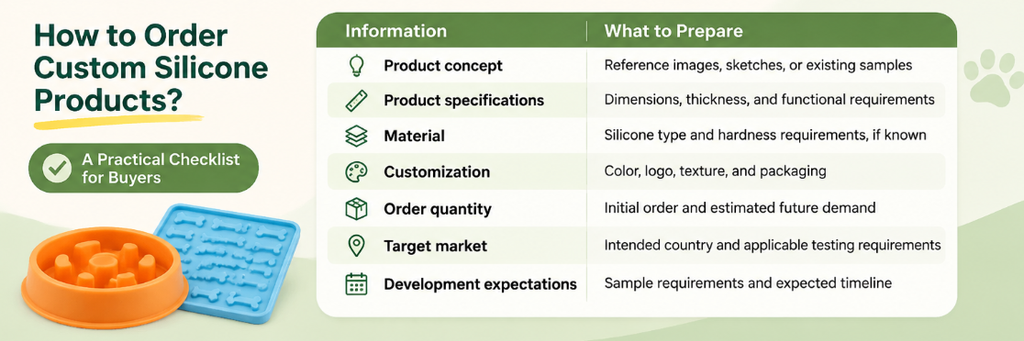
If you do not have a finished drawing, start with your product reference images and explain how you want the product to function.
An experienced custom silicone products manufacturer can help review the initial concept, discuss possible structures, and identify the information needed before mold development.
For international buyers considering Vietnam as a manufacturing destination, it is also worth comparing different production capabilities rather than focusing only on location.
For example, searching for pvc injection molding Vietnam may lead to factories specializing in thermoplastic injection molding. However, PVC injection molding and silicone molding are different manufacturing processes. A factory experienced in PVC production is not automatically qualified to develop silicone products.
Always confirm the manufacturer’s actual experience with the material and molding process required for your project.
Choosing the Right Custom Silicone Products Manufacturer
Investing in a custom silicone mold is an important decision, especially for brands introducing new products or expanding their existing product lines.
The right manufacturing partner should be able to do more than provide a mold quotation. They should understand your product requirements, evaluate design feasibility, communicate potential risks, support sample development, and maintain consistent production quality.
At Junle Vietnam, we provide silicone product development and OEM/ODM manufacturing services, including mold development, product customization, and mass production.
Whether you are developing a new silicone lick mat, feeding bowl, slow feeder, or another pet accessory, our team can work with your product concept and customization requirements throughout the development process.
A well-planned mold is not just the starting point of production. It is an important foundation for creating a product that can be manufactured consistently and developed for long-term market demand.